What are the president’s war powers?
Who decides when the United States goes to war?
Recent debate about U.S. military action against Iran has raised questions about what authority a president has to launch military operations. The U.S. Constitution divides war powers between Congress and the president, creating a system of shared responsibility intended to prevent unilateral decisions about war.
Article I of the Constitution gives Congress the authority to declare war, raise and fund the military, and regulate the armed forces. Article II designates the president as commander in chief, giving them authority to direct military operations once forces are deployed.
In practice, this structure has produced ongoing tension. Presidents argue they must be able to act quickly to defend U.S. interests, while many members of Congress maintain that sustained military conflict requires explicit legislative approval.
What can a president legally do without Congress?
Presidents from both parties have historically ordered limited military actions without a formal declaration of war. These actions are typically justified under the president’s authority as commander in chief and the need to respond quickly to threats, with, for example, airstrikes, targeted operations, or short-term deployments intended to deter adversaries or protect U.S. personnel.
Some legal scholars argue the president may initiate limited defensive or short-duration operations, while sustained conflict or major escalation requires congressional authorization.
What is the War Powers Resolution?
In 1973, Congress passed the War Powers Resolution amid concerns that presidential authority had expanded too far during the Vietnam conflict (which, notably, Congress never formally declared a war). The law attempts to clarify the balance of power by requiring three steps when U.S. forces are introduced into hostilities:
The president must notify Congress within 48 hours of deploying U.S. forces into armed conflict or situations where hostilities are imminent.
The president is expected to consult with Congress before introducing forces when possible.
Military operations must end within 60 days unless Congress authorizes the action or extends the deadline.
Presidents from both parties have often questioned the constitutionality of the War Powers Resolution and sometimes complied with it only partially, reporting military actions while still asserting independent executive authority over military deployments.
This figure from the War Powers Resolution Reporting Project (Reiss Center on Law and Security) illustrates the number of reports made by presidents through 2019. (For reference, President Trump has made 7 additional reports since.)
Figure 1. Number of 48-Hour Reports Per Presidential Term (Source: https://warpowers.lawandsecurity.org/findingsandanalysis/)
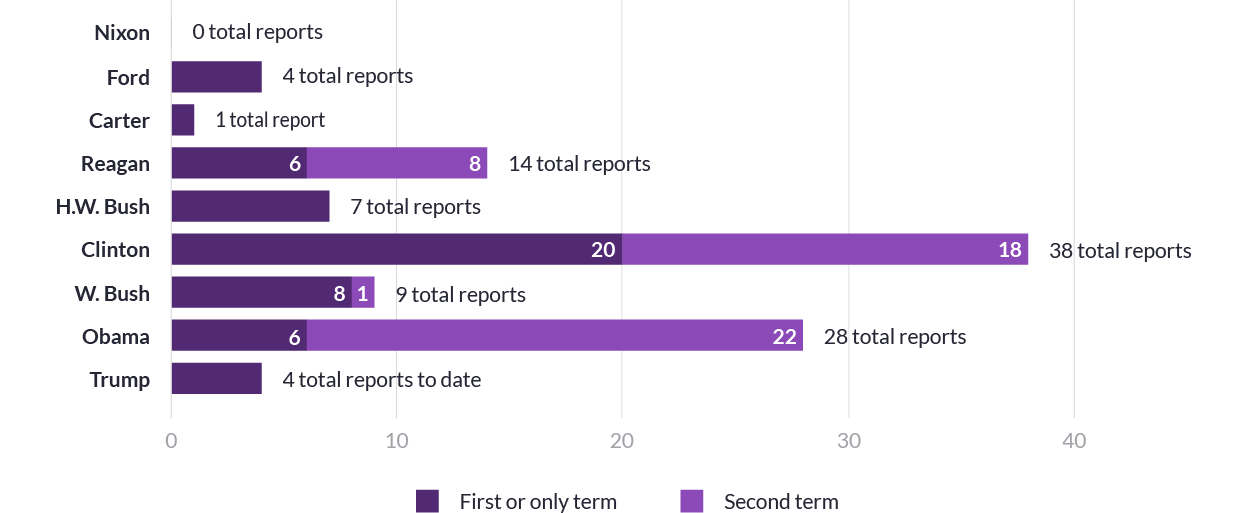
A “48-hour report” is a formal notice the president must send to Congress within 48 hours of deploying U.S. armed forces into certain military situations abroad when there is no declaration of war.
How does this apply to the military action against Iran?
The current debate stems from President Trump’s decision to order U.S. military strikes against Iranian targets as part of a joint U.S.–Israel campaign known as Operation Epic Fury, which has killed upwards of a thousand Iranians as of March 9, 2026, including Iran's supreme leader, Ayatollah Ali Khamenei.
The strikes were announced by the president in a public address on Truth Social and were carried out without a new authorization from Congress.
Supporters of the decision argue that the president has authority as commander in chief to take rapid military action to protect U.S. forces, respond to threats, and deter adversaries. Critics across the political spectrum contend that direct military action against another sovereign state, especially one that could lead to sustained conflict, should require congressional authorization.
Why does this matter for democracy?
Presidents of both parties have authorized military actions without formal declarations of war, raising recurring questions about where executive authority ends and congressional oversight begins. Following recent rapid military actions in Venezuela, this debate has only intensified.
When major military decisions unfold quickly and repeatedly, it becomes harder for Congress and the public to fully debate their legal basis, strategy, and consequences. Maintaining clear constitutional boundaries and meaningful congressional oversight helps ensure that decisions about war remain subject to democratic accountability rather than becoming routine exercises of executive power.
The Founders believed decisions about war should involve multiple branches of government and placed the primary authority to initiate war with Congress, reflecting their concern about concentrating too much power in a single executive.
Why does this matter for Jewish communities?
Jewish history offers many reminders of how vulnerable minority communities can become when political power is concentrated in a single leader or branch of government. In several countries during the 20th Century, democratic institutions weakened as executive authority expanded and legislatures and courts lost their ability to provide meaningful oversight.
The American constitutional system was designed in part to prevent that kind of concentration of power by dividing authority and requiring checks across branches of government. While the Jewish community holds a wide range of views on the current military campaign against Iran, it’s in our long-term interest to maintain clear limits on unilateral executive power and strengthen the institutional guardrails that protect democratic stability and minority rights.
What can be done?
Learn
Review how the Constitution divides authority between Congress and the president on matters of war and national security and explore public datasets on presidential war powers reporting.
Speak
Consider where you believe the line should be drawn between executive authority and congressional approval.
Act
Ask your federal elected officials where they stand on congressional authorization for military action and how they believe the War Powers Resolution should be enforced.
A More Perfect Union mobilizes the American Jewish community to protect and strengthen democracy. We’re committed to inspiring more American Jews to champion democracy through thoughtful, nonpartisan reflections on the challenges and choices facing our nation today. Never miss an update, subscribe today.